Medicine and Miracles in the High Desert by Erica M. Elliott M.D
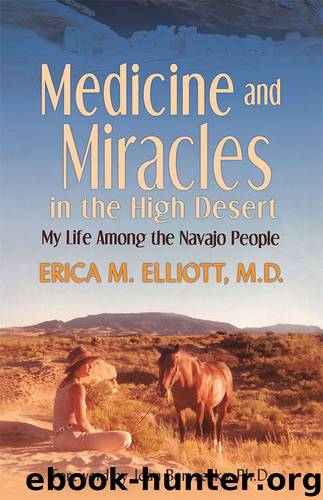
Author:Erica M. Elliott M.D. [Erica M. Elliott, M.D.]
Language: eng
Format: epub
ISBN: 9781982221058
Publisher: Balboa Press
Published: 2019-02-18T05:00:00+00:00
My friend Marshall
On one of the visits, I counted 597 sheep and goats in the corral. Lee Tome’s livestock also included a herd of cows and a few horses. By traditional Navajo standards, Lee Tome was a wealthy man. Marshall said that at one time his father owned well over one thousand sheep and goats, but had to sell half of his herd because of the government’s concerns about overgrazing.
I had never encountered this kind of wealth among the families I had visited with my students. Some of the families who lived in remote areas were desperately poor and without livestock. They relied on help from relatives and the local churches just to survive.
After my third visit, I attempted to have a conversation with Virginia and Lee Tome in Navajo. But I ran out of things to say after about ten minutes of asking basic questions like, “What are the names of your dogs? How many children do you have? How many sheep? How many goats? Do you have cows? How far away is the trading post? Where do you get your water from?” I said their land was beautiful, and I thanked them for the food they gave me to eat. I added that I liked their horses. They laughed while I struggled to continue the conversation. They spoke only a few words of heavily accented English, like “ships” for sheep, “coos” for cows, and “wabie” for water. After I ran out of things to say in Navajo, we didn’t speak at all and just sat together in a timeless state of silence.
Seeing my eagerness to learn more about Navajo language and culture, Marshall suggested that I spend time living with his parents to truly immerse myself in traditional life and become more conversant in Navajo. I thought about his suggestion, imagining myself herding sheep. It sounded like a great idea. The school year was almost over, so I could start at the beginning of June.
Marshall told his family about my desire to herd sheep and get a close-up view of traditional Navajo life. His parents sat in silence for a few long moments and then both of them burst out laughing at the same time. When they realized that Marshall spoke in earnest, they began discussing among themselves the unusual request. Marshall told me they needed time to think about it.
Morris was the family’s sheepherder. A few weeks after Marshall proposed to his parents that his white schoolteacher friend could herd their sheep, Morris decided to retire from sheepherding and agreed to give me his job. His parents offered to pay me $100 a month, along with some priceless old Navajo silver and turquoise jewelry, in exchange for herding their 597 sheep and goats.
By the time the school year ended, I had made up my mind not to return that summer to the University of Northern Arizona to complete my master’s degree in bilingual and bicultural education, as previously planned. Instead, I decided to become a sheepherder in Red Rock, Arizona.
Download
This site does not store any files on its server. We only index and link to content provided by other sites. Please contact the content providers to delete copyright contents if any and email us, we'll remove relevant links or contents immediately.
Still Foolin’ ’Em by Billy Crystal(36363)
We're Going to Need More Wine by Gabrielle Union(19052)
Plagued by Fire by Paul Hendrickson(17417)
Pimp by Iceberg Slim(14520)
Molly's Game by Molly Bloom(14149)
Becoming by Michelle Obama(10032)
When Breath Becomes Air by Paul Kalanithi(8450)
Educated by Tara Westover(8059)
The Girl Without a Voice by Casey Watson(7891)
The Incest Diary by Anonymous(7702)
Note to Self by Connor Franta(7673)
How to Be a Bawse: A Guide to Conquering Life by Lilly Singh(7492)
The Space Between by Michelle L. Teichman(6944)
What Does This Button Do? by Bruce Dickinson(6210)
Imperfect by Sanjay Manjrekar(5881)
Permanent Record by Edward Snowden(5852)
A Year in the Merde by Stephen Clarke(5441)
Shoe Dog by Phil Knight(5274)
Promise Me, Dad by Joe Biden(5157)
